Populations in motion
Follow the migrations, replacements, mixtures, and local continuities that assembled Europe and reshaped peoples across Eurasia.
A new book by Davide Piffer
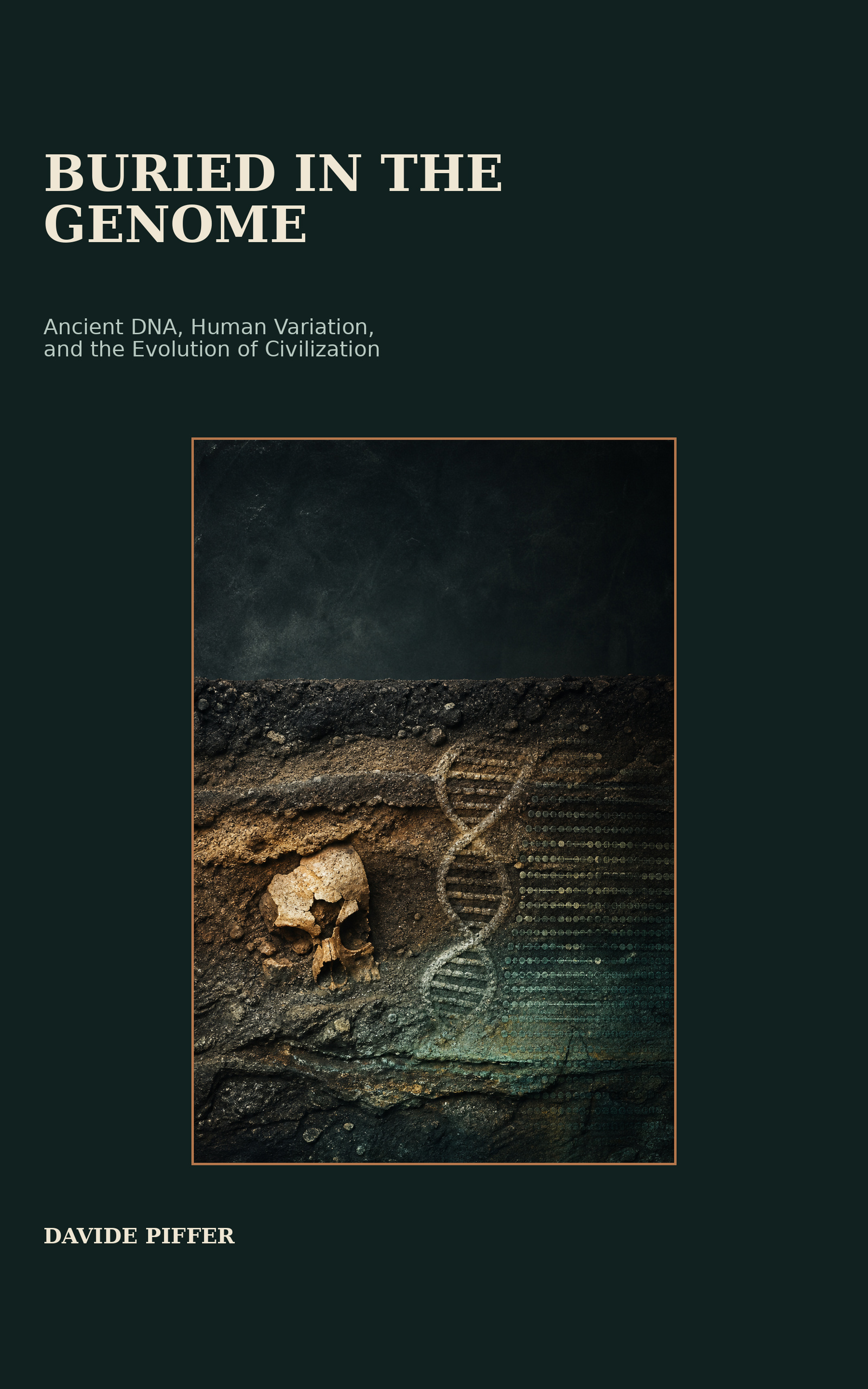
Ancient DNA, Human Variation, and the Evolution of Civilization
Human history is written not only in ruins and chronicles, but in DNA. Follow the evidence from ancient genomes to the migrations, adaptations, and population changes that shaped civilization.
Buy the digital edition direct, or choose Kindle and paperback on Amazon.
EPUB + PDF · Kindle · Paperback
Every living genome is an archive—of migrations survived, environments endured, and populations transformed.
Buried in the Genome brings ancient DNA into conversation with archaeology, history, and quantitative genetics. It explains what genetic distance actually measures, why ancient populations cannot be reduced to modern labels, and how traits changed long after the first great migrations.
The result is a wide-ranging account of human variation that moves from Neanderthals and early farmers to Rome, modern Italy, and the unresolved question of how biological and cultural evolution shape one another.
Follow the migrations, replacements, mixtures, and local continuities that assembled Europe and reshaped peoples across Eurasia.
Trace the separate histories of pigmentation, height, cognition, and other polygenic traits across thousands of ancient genomes.
Explore how agriculture, climate, institutions, and selection may have interacted as increasingly complex societies emerged.
Five parts · Twelve chapters
A narrative for general readers, followed by technical appendices for those who want to inspect the data, models, and robustness tests.
Genetic distance, population structure, ancient DNA, and the limits of polygenic prediction.
How Europe was assembled and how peoples form through movement, mixture, and history.
Pigmentation, stature, and brains before and after the Paleolithic.
The farming transition, cold-winter hypotheses, and selection within complex societies.
Rome, regional reversals, and Italy as a population-genetic case study.
A science of change
Ancient DNA has turned human history from a gallery of static types into a moving picture of populations, traits, and societies.
Get in touch
For research collaborations, questions about the book, or technical problems with your purchase or downloads, contact Davide directly.
pifferdavide@gmail.comAvailable now